Introduction
Forests cover approximately 31% of the world’s land surface, yet this percentage continues to decrease at an alarming rate due to human activities. This paper examines the critical relationship between deforestation and climate change, analyzing how the widespread removal of forests contributes to global warming and disrupts global climate systems. By understanding this relationship, we can better appreciate the urgency of forest conservation efforts and develop effective strategies to mitigate the environmental consequences of deforestation.
Understanding Deforestation
Definition and Methods
Deforestation refers to the permanent removal of trees to make land available for non-forest uses. The primary methods of forest clearing include clear-cutting (cutting down all trees in an area), selective logging (removing only certain species or sizes of trees), slash-and-burn agriculture (cutting and burning forests to create fields), and forest fires (both natural and human-caused). According to the Food and Agriculture Organization (FAO), approximately 10 million hectares of forest are lost each year, equivalent to losing a football field of forest every 2 seconds (FAO, 2020).
Regions Most Affected
The regions experiencing the highest rates of deforestation currently include:
- The Amazon Basin, spanning Brazil, Peru, Bolivia, Colombia, and other South American countries, contains portions of the Amazon rainforest that continue to experience significant deforestation, with Brazil accounting for the largest share.
- Southeast Asia: Indonesia, Malaysia, and Myanmar have lost substantial forest cover due to palm oil plantations, paper production, and timber extraction.
- Central Africa: The Congo Basin, the world’s second-largest tropical forest region after the Amazon, faces increasing deforestation pressure, particularly in the Democratic Republic of Congo, Cameroon, and Gabon.
Major Drivers of Deforestation
Multiple interconnected factors drive global deforestation:
- Agricultural Expansion: The conversion of forests to agricultural land represents the most significant driver of deforestation globally, accounting for approximately 73% of forest clearing worldwide (Curtis et al., 2018). This includes:
- Commercial agriculture (soybean fields, cattle ranching, palm oil plantations)
- Subsistence farming by small-scale farmers
- Logging Operations: Both legal and illegal timber harvesting contribute significantly to forest degradation and eventual deforestation, especially in tropical regions.
- Infrastructure Development: Road construction, dam building, and energy projects fragment forests and open previously inaccessible areas to further development.
- Mining Activities: The extraction of minerals, oil, and gas often requires clearing forest areas and introduces pollution that degrades surrounding ecosystems.
- Urban Expansion: As cities grow, surrounding forests are often cleared to accommodate housing, industrial zones, and commercial centers.
READ MORE: How does greenwashing mislead consumers about sustainability?
Case Study: The Brazilian Amazon
The Brazilian Amazon represents a critical case study in deforestation dynamics. Between August 2019 and July 2020, deforestation in the Brazilian Amazon increased by 9.5% compared to the previous year, reaching 11,088 square kilometers (INPE, 2020). This acceleration is primarily attributed to:
- Weakened environmental protections and enforcement
- Expansion of cattle ranching (Brazil is the world’s largest beef exporter)
- Soybean production for global markets
- Illegal logging operations
- Land speculation and clearing for property claims
The situation in the Amazon is particularly concerning because this rainforest contains approximately 90-140 billion metric tons of carbon, making it one of the world’s most important carbon sinks (Baccini et al., 2017).
Forests and Climate Regulation
The Carbon Cycle and Forests as Carbon Sinks
Forests play a crucial role in the global carbon cycle by absorbing carbon dioxide (CO₂) through photosynthesis and storing it in biomass (trunks, branches, leaves, and roots) and soils. This
process, known as carbon sequestration, helps regulate atmospheric CO₂ concentrations. The carbon cycle operates through several pathways:
- Trees absorb CO₂ from the atmosphere during photosynthesis
- Carbon is stored in living biomass and forest soils
- When trees die and decompose naturally, some carbon returns to the atmosphere
- When forests are burned or cleared, large amounts of stored carbon are rapidly released
Forests currently sequester approximately 2.6 billion tons of carbon dioxide annually, equivalent to about one-third of annual fossil fuel emissions (Pan et al., 2011).
Climate Regulation Mechanisms
Forests regulate climate through several interconnected mechanisms:
Carbon Sequestration
Different forest types vary in their carbon storage capacity:
- Tropical forests: 200-400 tons of carbon per hectare
- Temperate forests: 150-320 tons of carbon per hectare
- Boreal forests: 90-200 tons of carbon per hectare, with significant additional storage in soils
Evapotranspiration and Water Cycling
Trees release water vapor through transpiration, contributing to cloud formation and precipitation. The Amazon rainforest, for example, generates approximately 20% of its own rainfall through this mechanism. This “flying river” effect also transports moisture to other regions, affecting rainfall patterns thousands of kilometers away.
Albedo Effects
Forests influence the Earth’s albedo (the reflection of solar radiation). While darker forests absorb more solar radiation than open areas, their cooling effects through evapotranspiration and carbon sequestration typically outweigh this warming influence, particularly in tropical regions.
Biodiversity and Ecosystem Services
Forest biodiversity strengthens ecosystem resilience to climate change. Diverse forests are more resistant to diseases, pests, and extreme weather events, maintaining their climate regulation functions even under stress.
Forest Degradation vs. Deforestation
Forest degradation differs from deforestation in that tree cover remains, but forest quality, density, and health decline. This process can significantly impact climate regulation even when forests aren’t completely removed. Degraded forests store less carbon, are more vulnerable to fires, and provide reduced ecosystem services compared to intact forests.
According to Baccini et al. (2017), tropical forest degradation may contribute almost as much to carbon emissions as deforestation.
Climate Change Impacts of Deforestation
Contribution to Greenhouse Gas Emissions
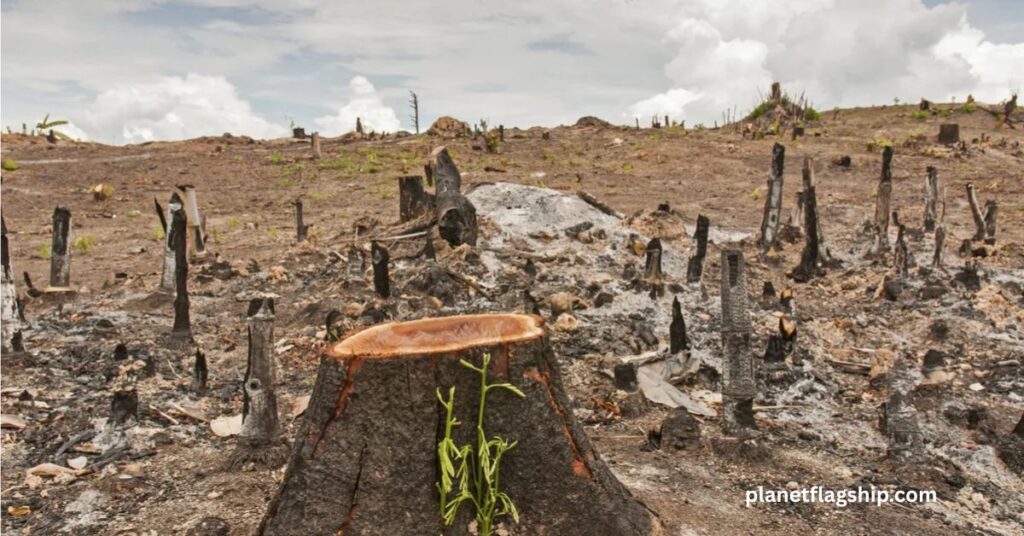
Deforestation and forest degradation contribute approximately 10-15% of global greenhouse gas emissions annually (IPCC, 2019). When forests are cleared or burned:
- Stored carbon is released as CO₂
- Methane (CH₄) is released during burning and from decomposition in flooded areas
- Nitrous oxide (N₂O) is released from soil disturbance and fertilizer use in converted agricultural lands
Between 2015 and 2020, global deforestation released approximately 5.5 billion tons of CO₂ equivalent per year into the atmosphere (WRI, 2021).
Feedback Loops
Deforestation creates several dangerous feedback loops that can accelerate climate change:
- Reduced Carbon Sequestration: As forests shrink, less CO₂ is removed from the atmosphere, increasing the concentration of greenhouse gases.
- Forest Fires: Climate change intensifies drought, making remaining forests more susceptible to fires, which release more carbon and further reduce forest cover.
- Changing Rainfall Patterns: Deforestation reduces precipitation, creating drier conditions that stress remaining forests and increase vulnerability to fires and disease.
- Forest Die-back: As climate conditions change, some forest ecosystems may reach tipping points where they can no longer regenerate or maintain their structure, potentially converting to different ecosystem types with lower carbon storage capacity.
The Amazon rainforest, for example, may be approaching a tipping point at which deforestation combined with climate change could trigger the conversion of parts of the forest to savanna, releasing massive amounts of stored carbon and permanently altering regional climate patterns (Lovejoy & Nobre, 2018).
Regional Climate Impacts
Deforestation significantly alters regional climates:
- Rainfall Reduction: Studies show that large-scale deforestation in the Amazon could reduce rainfall by up to 20% in the region and affect precipitation patterns across South America (Spracklen & Garcia-Carreras, 2015).
- Temperature Increases: Deforested areas experience higher surface temperatures due to reduced evaporative cooling. Urban areas near deforested regions often see temperature increases of 1-3°C.
- Increased Extreme Weather Events: Deforestation contributes to more severe droughts, floods, and heat waves. For example, the 2015 drought in São Paulo, Brazil, was linked to Amazonian deforestation, which disrupted the “flying rivers” that normally transport moisture to southeastern Brazil.
Biodiversity Loss and Ecosystem Degradation
Forests host approximately 80% of the world’s terrestrial biodiversity. Deforestation threatens this biodiversity, which is essential for:
- Climate resilience
- Ecosystem adaptation
- Future climate solutions (such as medicines, food crops, and other resources that may help humanity adapt)
Additionally, soil degradation following deforestation reduces carbon storage capacity and increases vulnerability to erosion and landslides, particularly during extreme weather events that are becoming more common with climate change.
Solutions and Conservation Approaches
International Initiatives
Several international efforts aim to reduce deforestation and its climate impacts:
- REDD+ (Reducing Emissions from Deforestation and Forest Degradation): This UN-backed framework provides financial incentives for developing countries to reduce
Emissions from forested lands. While REDD+ has shown promise in countries like Brazil (before recent policy reversals) and Indonesia, challenges remain in monitoring and verification, as well as in ensuring equitable benefit distribution.
- New York Declaration on Forests: This voluntary international declaration aims to halve deforestation by 2020 and end it by 2030. However, an assessment in 2019 found that signatories were not on track to meet these goals, with deforestation rates actually increasing in many regions.
- The Bonn Challenge: This global effort aims to restore 350 million hectares of degraded and deforested landscapes by 2030. As of 2020, over 60 countries had committed to restoring 210 million hectares.
Multi-level Policy Solutions
Effective deforestation reduction requires coordinated action at multiple levels:
International Level
- Strengthened trade regulations that prevent the import of products linked to deforestation
- Climate finance mechanisms that value standing forests more than cleared land
- Technology transfer for improved monitoring and enforcement
National Level
- Clear land tenure rights and recognition of indigenous territories
- Economic incentives for sustainable forest management
- Strong enforcement of existing forest protection laws
- Green development pathways that don’t rely on forest conversion
Local/Community Level
- Community-based forest management programs
- Sustainable livelihood alternatives for forest-dependent communities
- Local monitoring and enforcement networks
- Education and capacity building for sustainable practices
Reforestation and Afforestation Potential
Reforestation (replanting previously forested areas) and afforestation (establishing forests in new areas) represent important strategies for mitigating climate change:
- The IPCC estimates that increasing forest cover by 1 billion hectares could sequester approximately 200 billion tons of carbon (IPCC, 2019).
- Natural forest regeneration typically sequesters more carbon and provides greater biodiversity benefits than monoculture plantations.
- Strategic reforestation that considers native species, ecological connectivity, and community needs produces the best outcomes.
However, reforestation is not a silver bullet. Newly planted forests take decades to reach their full carbon-sequestration potential, and they cannot fully compensate for the loss of primary forests that have stored carbon for centuries or millennia.
Indigenous Stewardship
Indigenous peoples manage approximately 28% of the world’s land surface, including some of the most biodiverse and carbon-rich forests. Research consistently shows that indigenous territories often have lower deforestation rates than other areas, even compared to some protected areas (Garnett et al., 2018).
Key aspects of indigenous forest management include:
- Traditional ecological knowledge that has evolved over generations
- Sustainable harvesting practices that maintain forest integrity
- Cultural and spiritual connections to forest ecosystems
- Community enforcement systems that discourage illegal activities
Supporting indigenous land rights and incorporating traditional knowledge into forest management are among the most effective approaches to forest conservation globally.
ALSO READ: Climate Change and Inequality: The Growing Divide Between Rich and Poor Countries
FAQs About Deforestation and Climate Change
How does deforestation directly contribute to climate change?
Deforestation releases large amounts of carbon dioxide (CO₂) into the atmosphere when trees are cut or burned. Since forests naturally absorb CO₂, their removal weakens one of the Earth’s main carbon sinks. This increases greenhouse gas concentrations and accelerates global warming. Globally, deforestation contributes about 10–15% of annual emissions, making it one of the biggest drivers of climate change.
Why is the Amazon rainforest so important in the fight against climate change?
The Amazon stores 90–140 billion metric tons of carbon, making it one of the world’s largest carbon reservoirs. It also generates 20% of its own rainfall and influences weather patterns across South America. Large-scale deforestation in the Amazon risks pushing the forest toward a “tipping point,” where it may shift into savanna-like conditions, releasing enormous amounts of carbon and disrupting regional climate systems.
What are the biggest drivers of deforestation today?
The main drivers include agricultural expansion (cattle ranching, soy production, palm oil), logging, mining, and infrastructure development such as roads and dams. Urban growth also contributes by clearing forests for housing and industry. Agriculture alone accounts for about 73% of global deforestation, making it the most significant factor worldwide.
How does deforestation affect biodiversity and ecosystems?
Forests are home to nearly 80% of the world’s terrestrial biodiversity. When forests are cleared, species lose their habitats, leading to declines and extinctions. Deforestation also reduces ecosystem services like pollination, clean water, soil fertility, and climate regulation. Degraded ecosystems become less resilient, leaving both wildlife and humans more vulnerable to climate-related disasters.
What are the most effective solutions to reduce deforestation?
Effective solutions include strengthening international programs like REDD+, enforcing national forest protection laws, supporting indigenous land rights, promoting sustainable agriculture, and restoring degraded forests. Indigenous-managed lands often have the lowest deforestation rates, and reforestation can help absorb carbon—although it cannot replace the value of old-growth forests. A combination of global policies, local empowerment, and sustainable economic alternatives is essential for long-term success.
Conclusion
The relationship between deforestation and climate change represents one of the most pressing environmental challenges of our time. Forests serve as crucial carbon sinks, climate regulators, and biodiversity reservoirs, yet they continue to be cleared at alarming rates. The evidence clearly indicates that protecting existing forests, especially primary forests, must be a priority in climate change mitigation efforts.
Effectively addressing deforestation requires coordinated action across multiple scales—from international agreements to local community engagement. Solutions must recognize the complex socioeconomic drivers behind deforestation while creating incentives and opportunities for sustainable forest management. Additionally, indigenous knowledge and rights must be centered in conservation approaches.
While technological solutions like improved monitoring systems and sustainable intensification of agriculture are important, ultimately addressing deforestation requires fundamental shifts in how we value forests. When standing forests are recognized for their true economic, ecological, and cultural worth, rather than merely the land they occupy or the timber they contain, we will be better positioned to protect these vital ecosystems and mitigate climate change.
References
Baccini, A., Walker, W., Carvalho, L., Farina, M., Sulla-Menashe, D., & Houghton, R. A. (2017). Tropical forests are a net carbon source based on aboveground measurements of gain and loss. Science, 358(6360), 230-234.
Curtis, P. G., Slay, C. M., Harris, N. L., Tyukavina, A., & Hansen, M. C. (2018). Classifying drivers of global forest loss. Science, 361(6407), 1108-1111.
Food and Agriculture Organization (FAO). (2020). Global Forest Resources Assessment 2020. Rome, Italy.
Garnett, S. T., Burgess, N. D., Fa, J. E., Fernández-Llamazares, Á., Molnár, Z., Robinson, C. J.,
… & Leiper, I. (2018). A spatial overview of the global importance of Indigenous lands for conservation. Nature Sustainability, 1(7), 369-374.
INPE (National Institute for Space Research). (2020). PRODES – Amazon deforestation monitoring project. Brazil.
IPCC. (2019). Special Report on Climate Change and Land. Intergovernmental Panel on Climate Change.
Lovejoy, T. E., & Nobre, C. (2018). Amazon tipping point. Science Advances, 4(2), eaat2340.
Pan, Y., Birdsey, R. A., Fang, J., Houghton, R., Kauppi, P. E., Kurz, W. A., … & Hayes, D. (2011). A large and persistent carbon sink in the world’s forests. Science, 333(6045), 988-993.
Spracklen, D. V., & Garcia-Carreras, L. (2015). The impact of Amazonian deforestation on Amazon basin rainfall. Geophysical Research Letters, 42(21), 9546-9552.
World Resources Institute (WRI). (2021). Global Forest Review. Washington, DC.

John is a professional blogger and passionate advocate for environmental sustainability. With years of experience exploring eco-friendly practices and green innovations, he shares insightful articles on Planet Flagship to inspire a sustainable future. John’s expertise lies in making complex environmental topics accessible and actionable, empowering readers to make meaningful changes for the planet.